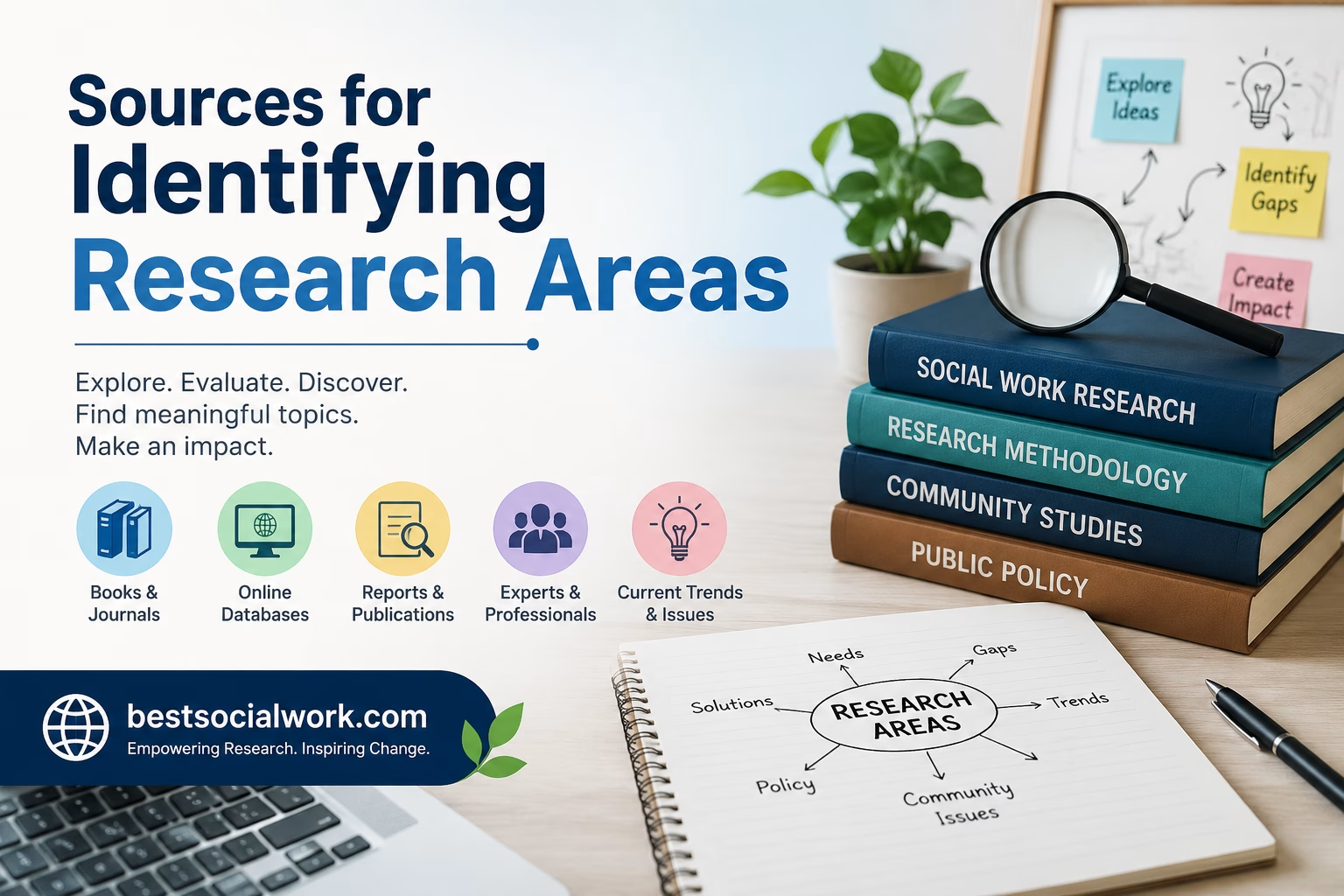
Sources for Identifying Research Areas
A research area is the broad field, subject, or domain of knowledge that a researcher selects for systematic investigation. It provides the overall framework within which specific research problems, questions, and objectives are identified and examined. As the general topic or discipline of study, a research area defines the scope and direction of the research, helping the researcher focus on particular issues, phenomena, populations, or areas of interest. It serves as the foundation of the research process and guides the development of research questions, hypotheses, and methodologies.
Following are the sources for identifying research areas:
· Personal and Practical Experience
Personal and practical experience is an important source for identifying research areas in social work, as it allows researchers to recognize real-life social problems through direct involvement in the field. Experiences gained during internships, community visits, volunteering, or professional social work practice often expose researchers to various issues such as poverty, domestic violence, unemployment, substance abuse, and child neglect. These firsthand observations help in developing a deeper understanding of social realities and generate meaningful research ideas. For example, a social work student working in a community rehabilitation center may observe a high rate of relapse among substance users due to lack of family support, which can lead to a research topic such as “The role of family support in preventing relapse among recovering drug users.”
· Existing Literature and Previous Research
Existing literature and previous research are important sources for identifying research areas in social work because they provide a comprehensive understanding of what has already been studied and what gaps still exist. By reviewing books, journals, research reports, theses, and academic articles, researchers can identify unanswered questions, inconsistencies, or under-researched issues that require further investigation. This process helps in refining ideas and selecting a relevant and researchable topic. For example, if previous studies on domestic violence in Nepal mainly focus on urban areas, a researcher may identify a gap and develop a new research area such as “Domestic violence against women in rural communities of Nepal” to explore under-researched settings.
· Theory and Interdisciplinary Perspectives
Theory and interdisciplinary perspectives are valuable sources for identifying research areas in social work because they provide conceptual frameworks and diverse viewpoints to understand social problems in a systematic way. Theories help explain human behavior and social phenomena, while interdisciplinary perspectives from sociology, psychology, economics, anthropology, and public health broaden the understanding of complex social issues. By applying theoretical concepts or integrating knowledge from different disciplines, researchers can identify new relationships, patterns, or unexplored areas for study. For example, using social learning theory, a researcher may observe that adolescents in a community are engaging in substance abuse by imitating peer behavior, leading to a research area such as “Influence of peer group behavior on substance abuse among adolescents in Nepal.”
· Consultations and Feedback
Consultations and feedback are important sources for identifying research areas in social work because they help researchers refine ideas through guidance from experienced professionals, supervisors, teachers, field experts, and community stakeholders. Such interactions provide practical insights into current social problems, research gaps, and feasible study areas that may not be easily identified through literature alone. Feedback also helps in narrowing broad interests into specific, researchable topics and ensures that the selected area is relevant and meaningful in the social context. For example, during consultation with a social work supervisor, a student interested in youth issues may be advised to focus on a specific problem such as mental health, leading to a research area like “Prevalence of depression among secondary school students in Nepal.”
· Contemporary Social and Political Issues
Contemporary social and political issues are important sources for identifying research areas in social work because they reflect current and emerging problems that directly affect individuals, families, and communities. Social workers often select research topics based on ongoing issues such as unemployment, migration, gender inequality, disaster impacts, policy changes, and human rights concerns. These issues highlight urgent social needs and help ensure that research findings are timely, relevant, and useful for policy and practice. For example, the increasing trend of foreign labor migration from Nepal and its social impact on families can lead to a research area such as “Psychosocial impact of foreign labor migration on left-behind families in Nepal.”
· Agency and Institutional Sources
Agency and institutional sources are important for identifying research areas in social work because organizations such as NGOs, INGOs, government offices, and community-based institutions regularly deal with various social problems and maintain records of service delivery and program implementation. These agencies often conduct needs assessments, baseline surveys, monitoring reports, and evaluation studies that reveal existing gaps, challenges, and priority issues in the community. Such information helps researchers identify practical and relevant research areas that are directly linked to social welfare services and policy implementation. For example, reports from a rehabilitation center may show a high rate of dropout among recovering substance users, leading to a research area such as “Factors affecting treatment dropout among clients in substance abuse rehabilitation centers in Nepal.”
· Intuition and Common Beliefs
Intuition and common beliefs can also serve as initial sources for identifying research areas in social work, as they reflect widely held perceptions, assumptions, and everyday understandings within a society. Intuition refers to a researcher’s personal insight or sense of curiosity about certain social issues, while common beliefs are shared ideas or notions prevalent among community members. Although these sources require careful verification through scientific inquiry, they often help generate meaningful research questions by highlighting issues that are taken for granted or not critically examined. For example, a common belief in some communities may be that “poverty leads to increased child labor,” which can guide a research area such as “Relationship between household poverty and child labor practices in rural Nepal.”
Characteristics of a Good Research Area
Discover more from Best Social Work
Subscribe to get the latest posts sent to your email.
https://shorturl.fm/DdIyP
https://shorturl.fm/2Dree
https://shorturl.fm/F2py7
https://shorturl.fm/QP5Pl
https://shorturl.fm/8MY2T
https://shorturl.fm/kLJhe
https://shorturl.fm/jMTH5
The best platform I have used in the Philippines so far. The customer support is very responsive and the payouts are fast. Big thumbs up for phkubraplus!