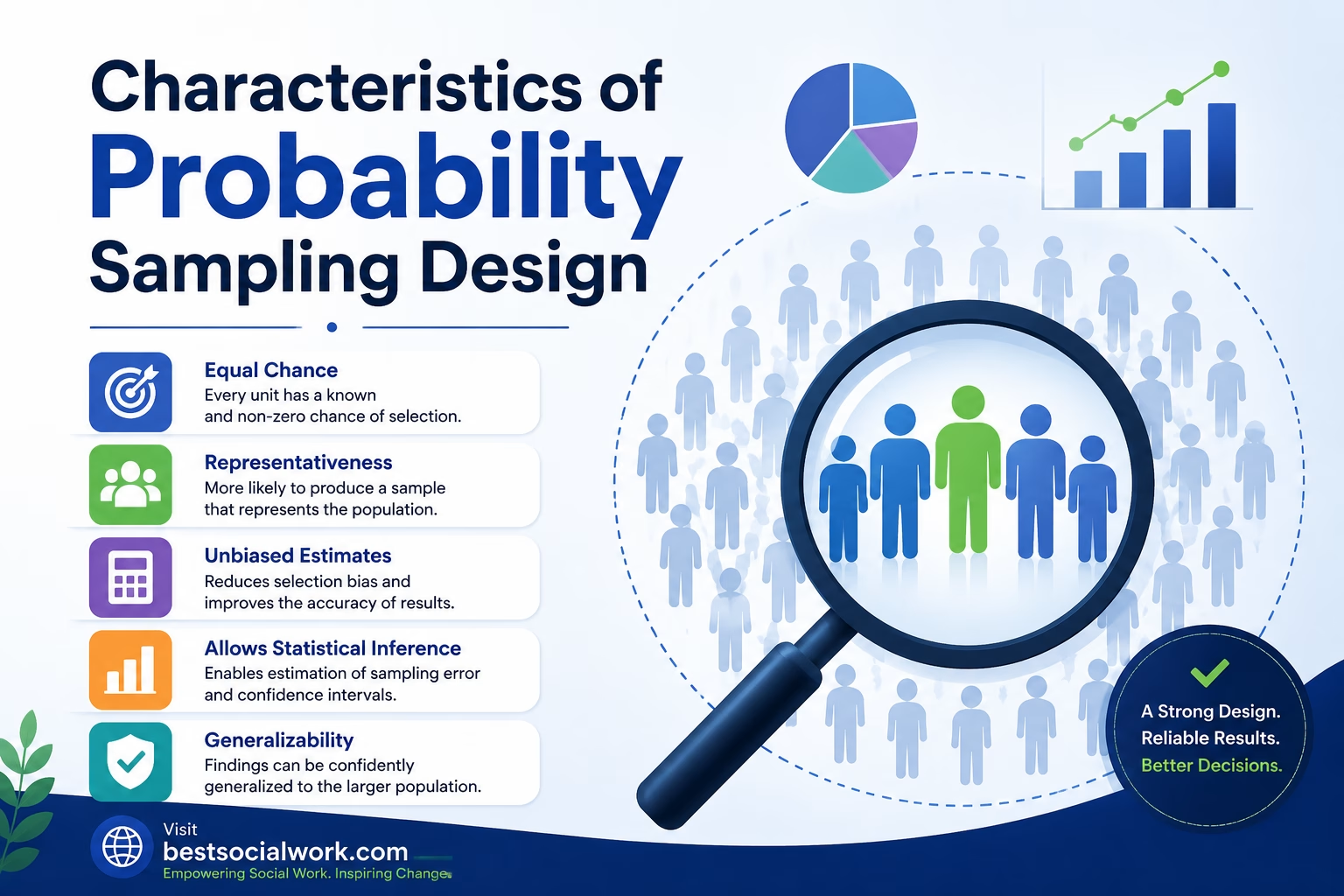
Characteristics of Probability Sampling Design
Probability Sampling Design is a sampling method in which every unit or element in the population has a known, non-zero probability of being selected for the sample. The selection of participants is carried out through a random process, ensuring that each member of the population has a fair chance of inclusion.
This design relies entirely on random selection mechanisms (like a lottery or a random number generator) rather than the subjective judgment of the researcher. Because the selection process is objective and mathematical, it eliminates human bias and provides a representative sample that reflects the true characteristics of the broader population.
Characteristics of Probability Sampling Design
A Probability Sampling Design is distinguished by its strict adherence to statistical theory and mathematical objectivity. These characteristics ensure that the data collected is scientifically rigorous and capable of representing a much larger population.
Here are the defining characteristics of a probability sampling design:
· Random Selection Mechanism
The Random Selection Mechanism is the foundational pillar of probability sampling, ensuring that the composition of the sample is governed entirely by mathematical chance rather than human choice. By utilizing objective tools like computer-generated random number algorithms, electronic tables, or physical lottery systems, this mechanism completely strips the researcher of any control or subconscious bias over who gets picked. For example, if a health organization wants to evaluate patient satisfaction across a hospital network, they would not simply interview the individuals who look the friendliest in the waiting room; instead, they would feed the database of all unique patient ID numbers into a randomizer software to automatically extract a sample of 500 participants, guaranteeing that every single patient has a known, objective opportunity to be selected.
· Known and Non-Zero Probabilities
The characteristic of Known and Non-Zero Probabilities dictates that every individual element within the target population must have a mathematically calculable chance of being chosen that is strictly greater than zero percent. This principle guarantees that no segment of the population is systematically or accidentally locked out of the study from the outset, which is vital for preserving the statistical integrity of the research. For example, if a retail company wants to sample 200 rewards-program members from their total database of 10,000 registered users, the known probability of selection for any single user is exactly 2% (calculated as $200 / 10,000$). Because every user is included on the master list, nobody has a 0% chance of being picked, allowing the company to use probability formulas to accurately estimate the shopping behaviors of their entire customer base.
· Presence of a Complete Sampling Frame
The Presence of a Complete Sampling Frame means that researchers must possess a comprehensive, highly accurate list or directory of every single member within the target population before random selection can occur. This frame serves as the physical or digital operational inventory that translates an abstract population into concrete, traceable units, ensuring that no eligible individual is omitted or duplicated. For example, if a researcher intends to study the burnout rates among registered nurses in a specific city, they cannot randomly sample without first acquiring an official, up-to-date registry from the local nursing board containing the names or license numbers of all active nurses in that jurisdiction. Without this exhaustive master list, it is mathematically impossible to assign precise selection probabilities or execute a truly random draw.
· Measurable Sampling Error
The characteristic of a Measurable Sampling Error means that because the sample is selected using strict probability laws, researchers can mathematically calculate the exact margin of error and confidence intervals to determine how much the sample’s findings might deviate from the true population. This ability to quantify uncertainty is unique to probability sampling and gives stakeholders a precise metric for data reliability, which is impossible to compute when using subjective, non-random sampling methods. For example, if a polling firm randomly surveys 1,000 citizens and finds that 55% support a new environmental policy, they can use statistical formulas based on the sample size and variance to calculate a margin of error of $\pm 3\%$ at a 95% confidence level. This tells the researchers that if they repeated the random draw a hundred times, ninety-five times out of a hundred the true population support would reliably fall between 52% and 58%.
· Statistical Generalizability (External Validity)
Statistical Generalizability, also known as high external validity, is the characteristic that allows researchers to confidently project the findings of a small sample onto the entire target population. Because a probability design relies on random selection, the chosen sample serves as an unbiased mathematical reflection—or microcosm—of the broader population’s diverse traits, ensuring that the relationships and patterns discovered in the study are not localized anomalies. For example, if a medical research team utilizes a randomized probability design to test a new blood pressure medication on a sample of 2,000 diverse adults across a nation, the high external validity of this design allows them to legally and scientifically claim that the observed efficacy and side effects will mirror what the millions of other adults in that country would experience.
· Elimination of Selection Bias
Elimination of Selection Bias is a vital characteristic of probability sampling, achieved because the randomization process strips the researcher of any personal discretion or subjective influence over who enters the study. By allowing a mechanical or mathematical tool to dictate the sample composition, this design prevents the systematic overrepresentation or underrepresentation of specific groups, which commonly occurs when human intuition or convenience takes over. For example, if a university wants to evaluate campus safety, a researcher utilizing a probability design cannot simply hand out surveys to students leaving the library at noon—a convenience method that would inherently bias the sample toward studious, daytime attendees while ignoring night students or those who avoid the library. Instead, by randomly generating a participant list from the complete student enrollment database, the researcher ensures that every lifestyle, schedule, and personality type has an equal opportunity to be included, eliminating any underlying investigator bias.
Purpose of sampling design in research
Discover more from Best Social Work
Subscribe to get the latest posts sent to your email.
https://shorturl.fm/WYbfG
https://shorturl.fm/muUkF
https://shorturl.fm/9EyLe
https://shorturl.fm/lJ88W
https://shorturl.fm/AeYFQ
https://shorturl.fm/Tqai6
https://shorturl.fm/jPBJU
https://shorturl.fm/5Qnqm
https://shorturl.fm/Z2Src
https://shorturl.fm/WfZw0
https://shorturl.fm/si5En
https://shorturl.fm/qSQPe
https://shorturl.fm/y1BCS
https://shorturl.fm/lJad1
https://shorturl.fm/IB0I6
https://shorturl.fm/osJo0
https://shorturl.fm/azueM
https://shorturl.fm/r5vXU
https://shorturl.fm/Zd4oX
https://shorturl.fm/kXHlx
https://shorturl.fm/zUx4n
https://shorturl.fm/ayWVf
https://shorturl.fm/HTE14
https://shorturl.fm/Hmwqc
https://shorturl.fm/mHNWd
https://shorturl.fm/OtNrX
https://shorturl.fm/65cCH
https://shorturl.fm/MexkD
https://shorturl.fm/DY3Kr
https://shorturl.fm/NrRgu
https://shorturl.fm/bU1bs
https://shorturl.fm/Lo5vf
https://shorturl.fm/p8hBI
https://shorturl.fm/8TH93
https://shorturl.fm/9A1SB
https://shorturl.fm/0oOA8
Cảm ơn bài viết. Với dịch vụ du học Hàn Quốc chuyên nghiệp, Letco giúp bạn tiết kiệm thời gian và chi phí chuẩn bị hồ sơ. Truy cập letco.vn để biết thêm.
Hocam Ellerinize Saglık Güzel Makale Olmuş Detaylı
Best slot site I have encountered in a while. The hit rate seems much better here than on other platforms. Give idslot97 a try!
https://addlinks.pro/W6H7i
WOW,Very wonderful
The content is really great
https://addlinks.pro/aRsK5
https://addlinks.pro/TpAGa
Best selection of slots I have seen in a while. The graphics are amazing and I won a nice amount last night on ph24jilipark.
I have tried a few of these but this one is by far the most stable. The live features are amazing and the interface is very user friendly. Check out phmatokliveapk if you want a real experience.
That was amazing
https://addlinks.pro/CSgVo
Hi,how are you
Really impressed with the payout speed here. It is hard to find a platform that doesn’t make you jump through hoops. Great experience so far with brzerumbet!
Its Amazing
Quick access and easy login. I appreciate how stable the platform is even during peak hours. Cheers! pk939gamelogin
I’ve been trying out a few platforms lately and this one really stands out. The interface is super smooth and everything just works. Definitely worth a look if you want a hassle-free experience. Check out bdkrikia