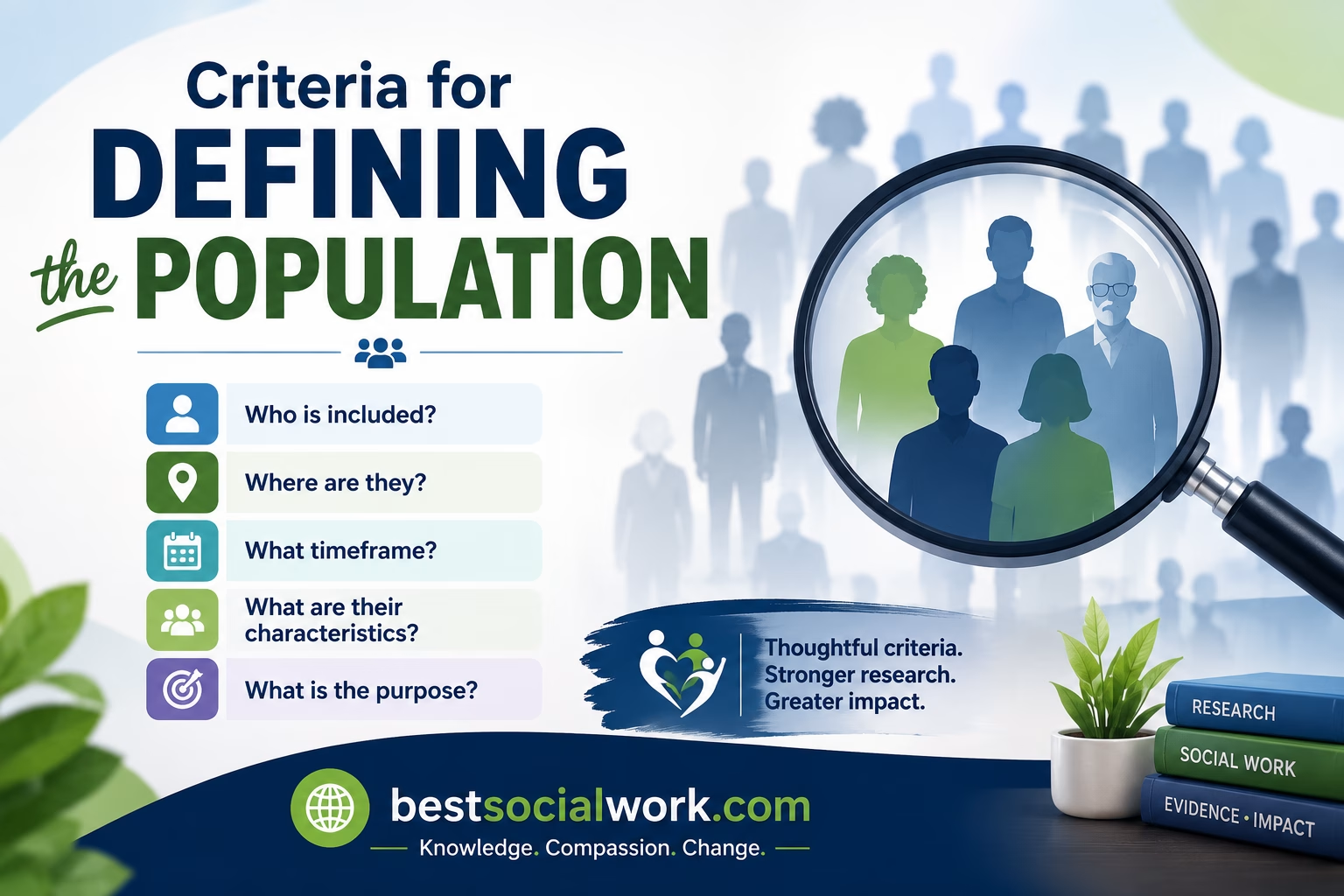
Criteria for Defining the Population
Defining a population is not a vague or intuitive step—it requires explicit, measurable criteria that determine exactly who or what is included (and excluded) from your study. In social work research, clear population criteria are essential for replicability, ethical review, sample selection, and generalizability.
Below are the formal criteria researchers use to define a population, organized from essential to more specialized considerations.
i. Inclusion Criteria (Who is IN?)
Inclusion criteria are the essential, measurable characteristics that an individual or unit must possess to be considered part of a research population. These criteria directly operationalize the population definition by specifying the exact demographic, clinical, experiential, geographic, or temporal attributes required for study membership. For example, a study examining a trauma-focused intervention for foster youth might define its population using the following inclusion criteria: “Children and adolescents aged 8 to 17 years, who have been in licensed foster care for a minimum of 90 continuous days, have a documented history of at least one DSM-5 Criterion A traumatic event as verified by child welfare case records, and score 30 or higher on the Child PTSD Symptom Scale (CPSS-5) indicating clinical levels of post-traumatic stress.” By establishing such precise inclusion criteria, the researcher ensures that every member of the population shares the core characteristics relevant to the research question, which enhances internal validity, supports replicability, and clearly communicates to readers and ethics reviewers exactly who the study will target.
ii. Exclusion Criteria (Who is OUT?)
Exclusion criteria are specific characteristics that remove an individual from the population even if they meet all inclusion criteria, serving to protect participant safety, prevent confounding variables, and maintain internal validity. While inclusion criteria define who belongs in the population, exclusion criteria refine that definition by identifying legitimate reasons for omission, such as the presence of co-occurring conditions that would obscure the intervention’s effect, inability to provide informed consent, safety risks, prior exposure to the study intervention, or logistical barriers that would prevent meaningful participation. For example, in a study evaluating a cognitive-behavioral therapy (CBT) intervention for depression among adults receiving outpatient mental health services, the exclusion criteria might state: “Individuals meeting inclusion criteria will be excluded from the population if they (a) have a current diagnosis of bipolar I disorder or active substance use disorder, as these conditions require different primary treatments that would confound depression outcome measures; (b) score 20 or above on the Columbia-Suicide Severity Rating Scale indicating acute suicidal ideation with intent, as participation would delay imminent crisis intervention; (c) have received CBT for depression within the past 12 months, as prior exposure would bias treatment response; or (d) are unable to attend weekly 90-minute sessions due to lack of reliable transportation or conflicting work schedules, as inconsistent attendance would compromise data integrity.” By articulating clear exclusion criteria, the researcher ethically narrows the population to those for whom the study question can be answered validly and safely, while transparently acknowledging which subgroups are not represented.
iii. Sampling Frame Criterion (The Operational List)
Sampling frame criterion refers to the operational list, roster, or database from which the research sample will actually be drawn, and it serves as a critical boundary that transforms an abstract population definition into a concrete, accessible source of potential participants. This criterion specifies the exact source, coverage limitations, and time reference of the list used to identify and contact members of the population, acknowledging that the sampling frame is often a practical subset of the broader target population. For example, a study investigating burnout among child welfare social workers might define its sampling frame criterion as follows: “The sampling frame consists of the human resources electronic personnel database of the State Department of Child and Family Services as of June 1, 2025, listing all full-time, salaried social workers currently assigned to frontline investigation or ongoing case management units across three regional offices (Northern, Central, and Metropolitan). This database includes employee names, work email addresses, office locations, and hire dates, but excludes contract workers, supervisors not carrying direct caseloads, and staff on extended leave without return dates. The frame is limited to active employees only, meaning it does not capture former workers who recently left the agency—a population that might report different burnout trajectories—nor does it include child welfare social workers employed by private foster care agencies or neighboring jurisdictions.” By explicitly defining the sampling frame criterion, the researcher makes transparent the gap between the theoretical population of interest and the actual accessible population, enabling readers to assess the generalizability of findings and the risk of coverage bias.
iv. Eligibility Window (Temporal Criteria)
Eligibility window, also known as temporal criteria, defines the specific time period during which an individual or case must be situated to qualify as a member of the research population, thereby transforming a potentially infinite or vague population into a finite, bounded one. This criterion specifies whether membership is determined at a single point in time, within a defined past or future interval, or through rolling admission as cases present over a recruitment period. For example, a study examining the effectiveness of a rapid re-housing intervention for families experiencing homelessness might state its eligibility window as follows: “The population includes all families with at least one child under age 18 who entered any of the three participating emergency shelters in Cook County, Illinois, between January 1, 2025 and December 31, 2025, and who completed a standardized housing intake assessment within 72 hours of arrival. Families who entered shelter before January 1, 2025 are excluded because they may have already received other housing services that would confound outcomes; families entering after December 31, 2025 are excluded due to study funding and follow-up period constraints. For families with multiple shelter episodes during the 12-month window, only the first episode meeting inclusion criteria will be considered to ensure statistical independence of observations.” By establishing a clear eligibility window, the researcher ensures temporal consistency across participants, allows for feasible recruitment and follow-up, and enables readers to understand the time-bound nature of the study’s conclusions.
v. Verifiability Criterion (How do you KNOW they belong?)
Verifiability criterion refers to the practical, ethical, and reliable method by which a researcher can confirm that an individual or case genuinely possesses each of the specified inclusion and exclusion characteristics, thereby ensuring that only eligible members enter the population. Without verifiability, even the most precisely written criteria remain theoretical and unenforceable, as the researcher cannot distinguish who truly belongs from who does not. This criterion requires that every defining attribute—demographic, clinical, experiential, or temporal—be measurable using existing records, standardized assessments, self-report instruments with known validity, direct observation, or legal documentation. For example, a study examining post-discharge outcomes among adults with serious mental illness might specify its verifiability criterion as follows: “Population membership will be verified through a two-stage process. First, potential participants’ names will be cross-referenced against the electronic discharge database of Western State Psychiatric Hospital to confirm inpatient admission lasting at least seven days within the 90-day recruitment window. Second, trained research assistants will administer the Mini International Neuropsychiatric Interview (MINI 7.0.2) to confirm a primary diagnosis of schizophrenia, schizoaffective disorder, or bipolar I disorder, excluding individuals whose MINI results indicate primary substance-induced psychosis or major depressive disorder without psychotic features. Hospital records will verify age (18–64 years) and length of stay, while a brief structured interview will confirm community residence post-discharge (excluding individuals discharged to jail, prison, or long-term inpatient facilities). Any individual lacking documentary or assessment-based confirmation for any single criterion will be excluded from the population.” By articulating a clear verifiability criterion, the researcher provides transparency about how population boundaries are operationalized in practice, enabling replication and allowing readers to assess the potential for misclassification bias.
vi. Boundary Criteria (Setting Limits)
Boundary criteria are the explicit limits—geographic, organizational, temporal, or numerical—that a researcher places on a population to make it feasible and finite, transforming an otherwise unbounded or unmanageable group into a concrete research population. Unlike inclusion criteria that describe who belongs, boundary criteria define the outer edges of the population by answering questions such as: Which locations? Which agencies? Which time period? What minimum or maximum values? These limits are often pragmatic but must be justified transparently, as they directly affect the generalizability of findings. For example, a study examining the relationship between caseload size and burnout among child protection workers might define its boundary criteria as follows: “The population is limited to child protection investigators employed by three county-level agencies in the Pacific Northwest—Multnomah County (Oregon), Clark County (Washington), and Lane County (Oregon)—selected because they serve urban, suburban, and mixed rural-urban populations while sharing the same state legal frameworks. Within each agency, only workers assigned exclusively to frontline investigation units with caseloads ranging from 15 to 35 active cases are included; workers with caseloads below 15 are excluded because they are typically supervisors or trainees, and caseloads above 35 are excluded because they represent fewer than five workers agency-wide, preventing stable analysis. Temporally, the population includes only workers employed continuously during the six-month data collection window (March 1, 2025 to August 31, 2025), excluding those on extended leave or who transferred into or out of investigative units during this period. A minimum of 12 months of tenure with the agency is required to ensure familiarity with documentation systems, while a maximum age of 65 is set to avoid confounding retirement-related attrition with burnout-related turnover.” By setting clear boundary criteria, the researcher acknowledges that every study population is necessarily limited, and by justifying those limits, the researcher enables readers to determine how far the findings might reasonably apply to other contexts, workers, or time periods.
| Criterion | Question You Must Answer |
| ✅ Inclusion | What characteristics must a person have to be included? (List each, with measurement method) |
| ✅ Exclusion | Who is excluded, and why? (Justify each exclusion ethically) |
| ✅ Sampling Frame | What list or roster will you draw from? What are its coverage limits? |
| ✅ Temporal Window | What time period defines membership? |
| ✅ Verifiability | How will you confirm each criterion? |
| ✅ Boundaries | What limits (geographic, size, setting) have you set, and why? |
Discover more from Best Social Work
Subscribe to get the latest posts sent to your email.
Kadıköy Su Kaçağı Tespiti Yapan Firmalar Online destek hattı çok faydalı, hemen bilgi alabildim. https://wellfastlogistics.com/
https://shorturl.fm/J9LNg
https://shorturl.fm/ccCj9
https://shorturl.fm/CTO5U
https://shorturl.fm/9hjFB
https://shorturl.fm/BX9fW
I’ve been using this site for a while now and the payout speed is impressive. Definitely one of the most reliable platforms I have found. Check out sv168top for a great experience.
https://addlinks.pro/m2fWI
The winning streaks I had last night were unbelievable. This site seems to have a very fair RNG. Definitely giving 133kcwin another go tonight.